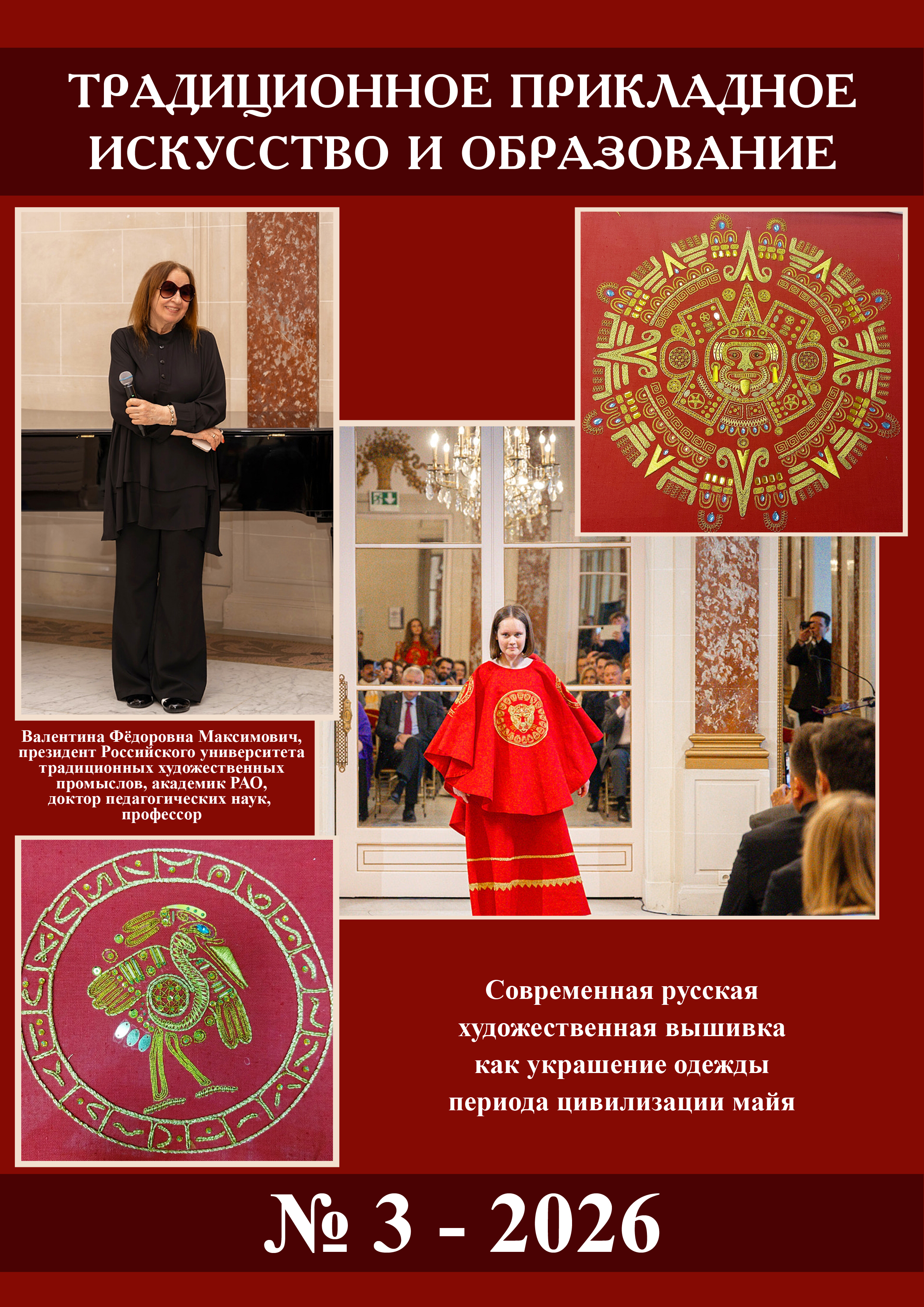
Министерство науки и высшего образования Российской Федерации
 Россиский университет традиционных художественных промыслов
ТРАДИЦИОННОЕ ПРИКЛАДНОЕ ИСКУССТВО И ОБРАЗОВАНИЕ
Сетевой электронный научный журнал
|
Министерство науки и высшего образования Российской Федерации
ТРАДИЦИОННОЕ ПРИКЛАДНОЕ ИСКУССТВО И ОБРАЗОВАНИЕ
Сетевой электронный научный журнал
|
 |
|
 |
 |
 |
 |
 |
 |
|
Учредитель - 
федеральноегосударственноебюджетное образовательное учреждение высшего образования «Российский университет традиционных художественных промыслов» http://vshni.ru |
Сентябрь, 2026 год. ВЫПУСК №3
………………………………………………………………………………
События и памятные даты
Поздравляем с 1 сентября!
………………………………………………………………………………
Happy September 1st!
………………………………………………………………………………
Fashion show of a clothing collection with artistic embroidery and artistic lace-making, created by students of the Russian University of Traditional Arts and Crafts as part of the Second World Public Assembly program
……………………………………………………………………………… ……………………………………………………………………………… Максимович В.Ф., академик Российской академии образования, доктор педагогических наук, профессор, президент ФГБОУ ВО «Российский университет традиционных художественных промыслов»
Традиционные художественные промыслы России: связь времен и культур
Аннотация: Статья посвящена созданию уникальной коллекции произведений, представляющих культуру периода цивилизации майя средствами традиционных художественных промыслов России. Данная коллекция впервые была представлена на международной выставке в Русском доме науки и культуры в Париже (Франция) в марте 2026 года. Научная проблема, решаемая в исследовании, предполагала теоретическое и практическое изучение возможности воплощения произведений цивилизации майя такими видами русских традиционных художественных промыслов, как художественная вышивка, художественное кружевоплетение, холмогорское косторезное искусство, ювелирное искусство, богородская художественная резьба по дереву, федоскинская лаковая миниатюрная живопись, ростовская финифть – при безусловном сохранении регионально-исторических художественно-технологических традиций каждого вида искусства Ключевые слова: традиционные художественные промыслы, художественная вышивка, художественное кружевоплетение, федоскинская лаковая миниатюрная живопись, ростовская финифть, богородская художественная резьба по дереву, холмогорское косторезное искусство, ювелирное искусство, дефиле, мезоамериканская культура, регионально-исторические художественно-технологические традиции, цивилизация майя Maksimovich V.F., academician of the Russian academy of education, doctor of pedagogical sciences, professor, president of the Russian university of traditional art crafts Traditional art crafts of Russia: the connection of times and cultures Abstract: The article examines the creation of a unique collection of artworks representing the culture of the ancient Maya civilization through the medium of Russian traditional art crafts. This collection was first presented at the international exhibition held at the Russian house of science and culture in Paris (France) in March 2026. The scientific problem addressed in the study involved the theoretical and practical exploration of the feasibility of embodying Maya civilization artifacts through various Russian traditional art crafts, including artistic embroidery, artistic lace-making, Kholmogory bone carving art, jewelry art, Bogorodskoye artistic wood carving, Fedoskino lacquer miniature painting and Rostov enamel. A fundamental condition of this project was the unconditional preservation of the regional and historical artistic-technological traditions inherent to each specific art type Keywords: traditional art crafts, artistic embroidery, artistic lace-making, Fedoskino lacquer miniature painting, Rostov enamel, Bogorodskoye artistic wood carving, Kholmogory bone carving art, jewelry art, fashion show, Mesoamerican culture, regional and historical artistic-technological traditions, Maya civilization ……………………………………………………………………………… Maksimovich V.F., academician of the Russian academy of education, doctor of pedagogical sciences, professor, president of the Russian university of traditional art crafts
Traditional art crafts of Russia: the connection of times and cultures
Abstract: The article examines the creation of a unique collection of artworks representing the culture of the ancient Maya civilization through the medium of Russian traditional art crafts. This collection was first presented at the international exhibition held at the Russian house of science and culture in Paris (France) in March 2026. The scientific problem addressed in the study involved the theoretical and practical exploration of the feasibility of embodying Maya civilization artifacts through various Russian traditional art crafts, including artistic embroidery, artistic lace-making, Kholmogory bone carving art, jewelry art, Bogorodskoye artistic wood carving, Fedoskino lacquer miniature painting and Rostov enamel. A fundamental condition of this project was the unconditional preservation of the regional and historical artistic-technological traditions inherent to each specific art type Keywords: traditional art crafts, artistic embroidery, artistic lace-making, Fedoskino lacquer miniature painting, Rostov enamel, Bogorodskoye artistic wood carving, Kholmogory bone carving art, jewelry art, fashion show, Mesoamerican culture, regional and historical artistic-technological traditions, Maya civilization ……………………………………………………………………………… Максимович В.Ф., академик Российской академии образования, доктор педагогических наук, профессор, президент ФГБОУ ВО «Российский университет традиционных художественных промыслов» Сайфулина Е.В., кандидат педагогических наук, заведующий кафедрой художественной вышивки ФГБОУ ВО «Российский университет традиционных художественных промыслов»
Интеграция традиционной художественной вышивки России в традиционные костюмы цивилизации майя
Аннотация: В статье описывается опыт создания в Российском университете традиционных художественных промыслов коллекции одежды, основой которой послужило искусство цивилизации майя. Освещается процесс разработки моделей одежды, выбора материалов и орнаментов с учётом исторических данных. Представлен поэтапный процесс декорирования одной из моделей коллекции видами художественной вышивки Ивановской области – ришелье и цветная гладь. Особое внимание уделяется совместной работе преподавателей и студентов, их вовлечению в научно-исследовательскую и практическую деятельность, а также развитию профессиональных качеств Ключевые слова: высшее образование в области художественной вышивки, коллекция, цивилизация майя, композиция, материалы, художественная вышивка, сетевое взаимодействие Maksimovich V.F., academician of the Russian academy of education, doctor of pedagogical sciences, professor, president of the Russian university of traditional art crafts Sayfulina E.V., candidate of pedagogical sciences, head of the department of artistic embroidery at the Russian university of traditional art crafts
Integration of traditional artistic embroidery of Russia into the traditional costumes of the Maya civilization
Abstract: The article describes the experience of creating a clothing collection at the Russian university of traditional art crafts, based on the art of the Maya civilization. The process of developing clothing models, selecting materials and choosing ornaments in accordance with historical data is highlighted. A step-by-step process of decorating one of the collection’s models with types of artistic embroidery from the Ivanovo region – specifically Richelieu and colored satin stitch – is presented. Special attention is paid to the collaborative work of instructors and students, their involvement in research and practical activities, as well as the development of their professional qualities Keywords: higher education in artistic embroidery, clothing collection, Maya civilization, composition, materials, artistic embroidery, network interaction ……………………………………………………………………………… Maksimovich V.F., academician of the Russian academy of education, doctor of pedagogical sciences, professor, president of the Russian university of traditional art crafts Sayfulina E.V., candidate of pedagogical sciences, head of the department of artistic embroidery at the Russian university of traditional art crafts
Integration of traditional artistic embroidery of Russia into the traditional costumes of the Maya civilization
Abstract: The article describes the experience of creating a clothing collection at the Russian university of traditional art crafts, based on the art of the Maya civilization. The process of developing clothing models, selecting materials and choosing ornaments in accordance with historical data is highlighted. A step-by-step process of decorating one of the collection’s models with types of artistic embroidery from the Ivanovo region – specifically Richelieu and colored satin stitch – is presented. Special attention is paid to the collaborative work of instructors and students, their involvement in research and practical activities, as well as the development of their professional qualities Keywords: higher education in artistic embroidery, clothing collection, Maya civilization, composition, materials, artistic embroidery, network interaction ……………………………………………………………………………… Сайфулина Е.В., кандидат педагогических наук, заведующий кафедрой художественной вышивки ФГБОУ ВО «Российский университет традиционных художественных промыслов» Шаповалова И.А., доктор педагогических наук, профессор, профессор кафедры гуманитарных дисциплин Института традиционного прикладного искусства – Московского филиала ФГБОУ ВО «Российский университет традиционных художественных промыслов)»
Межкультурный диалог в художественном творчестве: от археологических образов – к современному изделию
Аннотация: В статье представлен проект по разработке образа платья «Райский сад», вдохновлённого эстетикой цивилизации майя и объединяющего приёмы вышивки майя и русской художественной вышивки. Цель исследования – повышение профессионального уровня студентов и преподавателей в процессе реализации историко художественных идей в учебно проектной практике. Для этого был осуществлен анализ экспонатов Национального музея искусства в Мехико (Мексика), изучены конструкции и декор одежды терракотовых статуэток, выполненных майя, проведен сравнительный анализ видов вышивки, осуществлено художественное проектирование и опытная реализация изделия. В результате определена конструктивно технологическая основа (простая прямоугольная базовая выкройка с отдельно выполненными объемными элементами художественной вышивки), подобраны и адаптированы виды швов (тамбурный шов, цветная гладь, «кадомский вениз», «золотное шитье») и материалы (льняная ткань, фактурные нитки, современная фурнитура) Ключевые слова: коллекция, цивилизация майя, художественная композиция, материалы, вышивка, межкультурная интеграция Sayfulina E.V., candidate of pedagogical sciences, head of the department of artistic embroidery at the Russian university of traditional art crafts Shapovalova I.A., doctor of pedagogical sciences, professor, professor of the department of humanities at the Institute of traditional applied arts – Moscow branch of the Russian university of traditional art crafts Intercultural dialogue in artistic creation: from archaeological images to the modern artwork Abstract: The article presents a project dedicated to the development of the «Paradise Garden» dress design, inspired by the aesthetics of the Maya civilization and combining Maya embroidery techniques with Russian artistic embroidery. The aim of the research is to raise the professional level of students and instructors through the realization of historical and artistic ideas in educational project practice. To achieve this, an analysis of exhibits from the National Museum of Art in Mexico City (Mexico) was conducted, alongside a study of the construction and decoration of clothing on terracotta statuettes created by the Maya. A comparative analysis of embroidery types was carried out, followed by the artistic design and experimental implementation of the item. As a result, a constructive and technological foundation was determined (a simple rectangular basic pattern with separately crafted volumetric elements of artistic embroidery). Types of stitches (chain stitch, colored satin stitch, Kadom veniz, goldwork) and materials (linen fabric, textured threads, modern hardware) were selected and adapted Key words: collection, Maya civilization, artistic composition, materials, embroidery, intercultural integration ……………………………………………………………………………… Sayfulina E.V., candidate of pedagogical sciences, head of the department of artistic embroidery at the Russian university of traditional art crafts Shapovalova I.A., doctor of pedagogical sciences, professor, professor of the department of humanities at the Institute of traditional applied arts – Moscow branch of the Russian university of traditional art crafts
Intercultural dialogue in artistic creation: from archaeological images to the modern artwork
Abstract: The article presents a project dedicated to the development of the «Paradise Garden» dress design, inspired by the aesthetics of the Maya civilization and combining Maya embroidery techniques with Russian artistic embroidery. The aim of the research is to raise the professional level of students and instructors through the realization of historical and artistic ideas in educational project practice. To achieve this, an analysis of exhibits from the National Museum of Art in Mexico City (Mexico) was conducted, alongside a study of the construction and decoration of clothing on terracotta statuettes created by the Maya. A comparative analysis of embroidery types was carried out, followed by the artistic design and experimental implementation of the item. As a result, a constructive and technological foundation was determined (a simple rectangular basic pattern with separately crafted volumetric elements of artistic embroidery). Types of stitches (chain stitch, colored satin stitch, Kadom veniz, goldwork) and materials (linen fabric, textured threads, modern hardware) were selected and adapted Key words: collection, Maya civilization, artistic composition, materials, embroidery, intercultural integration ……………………………………………………………………………… Платонова О.Н., кандидат технических наук, заведующий кафедрой конструирования и моделирования одежды Института традиционного прикладного искусства – Московского филиала ФГБОУ ВО «Российский университет традиционных художественных промыслов»
Содержание обучения моделированию одежды на примере коллекции по мотивам цивилизации майя
Аннотация: В статье рассмотрена разработка и создание произведений на основе изучения художественного наследия цивилизации майя в рамках обучения моделированию одежды с художественной вышивкой, художественным кружевоплетением и художественной росписью ткани. Выполнение уникального проекта коллективом студентов и преподавателей Российского университета традиционных художественных промыслов включало исследование художественных образов и мотивов, интерпретацию символики, освоение принципов геометрического кроя и композиционного построения форм. Итогом проекта стала коллекция из восьми моделей одежды, вдохновленных художественным наследием цивилизации майя и декорированных при помощи традиционных регионально-исторических техник художественной вышивки, художественного кружевоплетения и художественной росписи ткани. Коллекция впервые была представлена в Париже в марте 2026 года Ключевые слова: содержание обучения моделированию одежды, костюм майя, художественная вышивка, художественная роспись ткани, символика, композиция, геометрия кроя, историческая интерпретация Platonova O.N., candidate of technical sciences, head of the department of clothing design and modeling at the Institute of traditional applied arts – Moscow branch of the Russian university of traditional art crafts Content of teaching clothing modeling on the example of a collection inspired by the Maya civilization Abstract: The article examines the development and creation of artworks based on the study of the artistic heritage of the Mayan civilization. This work was conducted within the framework of a clothing design course, incorporating artistic embroidery, artistic lace-making and artistic fabric painting. The implementation of this unique project by a team of students and faculty from the Russian university of traditional art crafts included research into artistic images and motifs, interpretation of symbolism and mastering the principles of geometric tailoring and compositional form construction. The project culminated in a collection of eight garments inspired by the artistic legacy of the Mayan civilization. The pieces were decorated using traditional regional and historical techniques of artistic embroidery, artistic lace-making and artistic fabric painting. The collection was first presented in Paris in March 2026 Keywords: Curriculum for teaching clothing design, Mayan costume, artistic embroidery, artistic fabric painting, symbolic motifs, composition, cutting geometry, historical interpretation ……………………………………………………………………………… Platonova O.N., candidate of technical sciences, head of the department of clothing design and modeling at the Institute of traditional applied arts – Moscow branch of the Russian university of traditional art crafts
Content of teaching clothing modeling on the example of a collection inspired by the Maya civilization
Abstract: The article examines the development and creation of artworks based on the study of the artistic heritage of the Mayan civilization. This work was conducted within the framework of a clothing design course, incorporating artistic embroidery, artistic lace-making and artistic fabric painting. The implementation of this unique project by a team of students and faculty from the Russian university of traditional art crafts included research into artistic images and motifs, interpretation of symbolism and mastering the principles of geometric tailoring and compositional form construction. The project culminated in a collection of eight garments inspired by the artistic legacy of the Mayan civilization. The pieces were decorated using traditional regional and historical techniques of artistic embroidery, artistic lace-making and artistic fabric painting. The collection was first presented in Paris in March 2026 Keywords: Curriculum for teaching clothing design, Mayan costume, artistic embroidery, artistic fabric painting, symbolic motifs, composition, cutting geometry, historical interpretation ……………………………………………………………………………… Швецова О.В., кандидат педагогических наук, старший преподаватель кафедры профессиональных дисциплин Института традиционного прикладного искусства – Московского филиала ФГБОУ ВО «Российский университет традиционных художественных промыслов»
Русская художественная вышивка как шедевр, восхищающий мир
Аннотация: В статье описывается создание коллекции «Майя», которая объединяет традиционные техники русской художественной вышивки и орнаментальные мотивы, изображенные на фресках, терракотовых статуэтках и керамических сосудах цивилизации майя. В работе рассматривается значение вышивки как средства культурной преемственности и духовного воспитания, а также её роль в сохранении этнической идентичности и культурных традиций. Описан образовательный процесс, включающий изучение исторических образцов, создание зарисовок, подбор колористических решений, разработку форэскизов и воплощение замысла в материале. Коллекция «Майя» демонстрирует возможность осмысленного синтеза культурных традиций и показывает, как традиционная русская вышивка может быть включена в проектирование современных моделей одежды, сохраняя свою аутентичность и художественную образность Ключевые слова: коллекция, культурное наследие, проектирование, стилизация, цивилизация майя, художественная вышивка Shvetsova O.V., candidate of pedagogical sciences, senior lecturer of the department of professional disciplines at the Institute of traditional applied arts – Moscow branch of the Russian university of traditional art crafts Russian artistic embroidery as a masterpiece admired by the world Abstract: The article describes the creation of the “Maya” collection, which combines traditional techniques of Russian artistic embroidery and ornamental motifs found on frescoes, terracotta statuettes and ceramic vessels of the Maya civilization. The work examines the significance of embroidery as a means of cultural continuity and spiritual upbringing, as well as its role in preserving ethnic identity and cultural traditions. The educational process is described, including the study of historical samples, the creation of sketches, the selection of color schemes, the development of preliminary sketches and the implementation of the design in material. The “Maya” collection demonstrates the possibility of a meaningful synthesis of cultural traditions and shows how traditional Russian embroidery can be incorporated into the design of modern clothing models, preserving its authenticity and artistic imagery Keywords: collection, cultural heritage, design, stylization, Maya civilization, artistic embroidery ……………………………………………………………………………… Shvetsova O.V., candidate of pedagogical sciences, senior lecturer of the department of professional disciplines at the Institute of traditional applied arts – Moscow branch of the Russian university of traditional art crafts Russian artistic embroidery as a masterpiece admired by the world Abstract: The article describes the creation of the “Maya” collection, which combines traditional techniques of Russian artistic embroidery and ornamental motifs found on frescoes, terracotta statuettes and ceramic vessels of the Maya civilization. The work examines the significance of embroidery as a means of cultural continuity and spiritual upbringing, as well as its role in preserving ethnic identity and cultural traditions. The educational process is described, including the study of historical samples, the creation of sketches, the selection of color schemes, the development of preliminary sketches and the implementation of the design in material. The “Maya” collection demonstrates the possibility of a meaningful synthesis of cultural traditions and shows how traditional Russian embroidery can be incorporated into the design of modern clothing models, preserving its authenticity and artistic imagery Keywords: collection, cultural heritage, design, stylization, Maya civilization, artistic embroidery ……………………………………………………………………………… Колобов В.Н., кандидат педагогических наук, заведующий мастерской косторезного искусства имени Н.Д. Буторина кафедры ювелирного и косторезного искусства ФГБОУ ВО «Российский университет традиционных художественных промыслов» Аннотация: В статье рассматривается экспериментальный образовательный проект студентов под руководством преподавателя, посвященный разработке и созданию художественных изделий из кости, выполненных в стилистике культуры майя с применением традиционных технологий холмогорской художественной резьбы по кости. В статье раскрыты цели и задачи проекта с подробным описанием этапов выполнения. Описаны предметы и объекты культуры майя, их значение и символика. Исследование демонстрирует возможности синтеза разноплановых художественных традиций и технологий в современном традиционном прикладном искусстве Ключевые слова: косторезное искусство, холмогорская резьба по кости, художественные изделия, мезоамериканская культура, артефакты, майя, технология, символизм Kolobov V.N., candidate of pedagogical sciences, head of the workshop of bone carving art named after N.D. Butorin at the department of jewelry and bone carving art of the Russian university of traditional art crafts Abstract: The article examines an experimental educational project by students under the guidance of a teacher, dedicated to the development and creation of bone carving artworks, executed in the style of Maya culture using traditional Kholmogory bone carving art techniques. The article reveals the goals and objectives of the project with a detailed description of the implementation stages. It provides a methodological rationale and description of Mayan cultural artifacts, their meanings and symbolism. The study demonstrates the possibilities of synthesizing diverse artistic traditions and technologies in contemporary traditional applied art Keywords: bone carving art, Kholmogory bone carving art, artistic items, Mesoamerican culture, artifacts, Maya, technology, symbolism ……………………………………………………………………………… Kolobov V.N., candidate of pedagogical sciences, head of the workshop of bone carving art named after N.D. Butorin at the department of jewelry and bone carving art of the Russian university of traditional art crafts Abstract: The article examines an experimental educational project by students under the guidance of a teacher, dedicated to the development and creation of bone carving artworks, executed in the style of Maya culture using traditional Kholmogory bone carving art techniques. The article reveals the goals and objectives of the project with a detailed description of the implementation stages. It provides a methodological rationale and description of Mayan cultural artifacts, their meanings and symbolism. The study demonstrates the possibilities of synthesizing diverse artistic traditions and technologies in contemporary traditional applied art Keywords: bone carving art, Kholmogory bone carving art, artistic items, Mesoamerican culture, artifacts, Maya, technology, symbolism ……………………………………………………………………………… Чуракова М.В., кандидат педагогических наук, заведующий кафедрой ювелирного и косторезного искусства ФБГОУ ВО «Российский университет традиционных художественных промыслов»
Традиции и эксперименты в современном образовании в ювелирном искусстве
Аннотация: В статье рассматривается методика профессиональной подготовки будущих художников-ювелиров, основанная на художественно-технологической экспериментально-исследовательской деятельности. Актуальность исследования обусловлена необходимостью сочетания традиционных ручных техник художественной обработки металлов с экспериментальным применением новых материалов, технологий и проектно-конструкторских решений. Методика представлена на примере разработки студентами коллекции ювелирных изделий по мотивам художественного наследия цивилизации майя. Раскрыты исследовательско-поисковый, проектно-экспериментальный, практический и контрольный этапы работы. Охарактеризованы содержание деятельности студентов и педагогическое сопровождение на каждом этапе, включая изучение культурно-исторических источников, анализ материалов и технологий, репликацию образцов, разработку эскизов и макетов, выполнение технологических проб, изготовление авторских изделий и оценку результатов. Определены исследовательские, композиционно-художественные и технологические критерии оценивания студенческих работ. Результатом реализации методики стала коллекция оригинальных ювелирных изделий, представленная на международной выставке в Париже Ключевые слова: профессиональная подготовка, художник-ювелир, ювелирное искусство, художественно-технологическая деятельность, экспериментально-исследовательская деятельность, проектирование ювелирных изделий, художественная обработка металлов, культура майя, авторские ювелирные изделия Churakova M.V., candidate of pedagogical sciences, head of the department of jewelry and bone carving art of the Russian university of traditional art crafts Traditions and experiments in contemporary jewelry art education Abstract: based on artistic-technological experimental research activities. The relevance of the study is due to the need to combine traditional hand techniques of artistic metalworking with the experimental application of new materials, technologies and design-engineering solutions. The methodology is presented through the example of students developing a collection of jewelry based on the artistic heritage of the Maya civilization. The research-exploratory, design-experimental, practical and control stages of the work are revealed. The content of student activities and pedagogical support at each stage are characterized, including the study of cultural and historical sources, analysis of materials and technologies, replication of samples, development of sketches and mock-ups, execution of technological tests, creation of original pieces and evaluation of results. Research, compositional-artistic and technological criteria for evaluating student works are defined. The result of implementing the methodology was a collection of original jewelry pieces, which was presented at an international exhibition in Paris Key words: professional training, jewelry artist, jewelry art, artistic and technological activity, experimental and research activity, jewelry design, artistic metalworking, Maya culture, original jewelry pieces ……………………………………………………………………………… Churakova M.V., candidate of pedagogical sciences, head of the department of jewelry and bone carving art of the Russian university of traditional art crafts
Traditions and experiments in contemporary jewelry art education
Abstract: based on artistic-technological experimental research activities. The relevance of the study is due to the need to combine traditional hand techniques of artistic metalworking with the experimental application of new materials, technologies and design-engineering solutions. The methodology is presented through the example of students developing a collection of jewelry based on the artistic heritage of the Maya civilization. The research-exploratory, design-experimental, practical and control stages of the work are revealed. The content of student activities and pedagogical support at each stage are characterized, including the study of cultural and historical sources, analysis of materials and technologies, replication of samples, development of sketches and mock-ups, execution of technological tests, creation of original pieces and evaluation of results. Research, compositional-artistic and technological criteria for evaluating student works are defined. The result of implementing the methodology was a collection of original jewelry pieces, which was presented at an international exhibition in Paris Key words: professional training, jewelry artist, jewelry art, artistic and technological activity, experimental and research activity, jewelry design, artistic metalworking, Maya culture, original jewelry pieces ……………………………………………………………………………… Салтанов М.А., кандидат педагогических наук, директор Федоскинского института лаковой миниатюрной живописи – филиала ФГБОУ ВО «Российский университет традиционных художественных промыслов» Лейтланд И.В., преподаватель Федоскинского института лаковой миниатюрной живописи – филиала ФГБОУ ВО «Российский университет традиционных художественных промыслов»
Федоскинская лаковая миниатюрная живопись: композиционно-технологические интерпретации
Аннотация: В статье рассматривается опыт выполнения учебных панно студентами первого курса направления подготовки 54.03.05 Традиционное прикладное искусство на основе сюжетов древней Мезоамерики. Цель исследования — выявить особенности применения грунтов, декоративных материалов и техник письма федоскинской лаковой миниатюрной живописи при выполнении учебных панно на основе изображений произведений древней Мезоамерики. В работе использовались педагогическое наблюдение и сравнительный анализ учебных художественных решений. Показано, что композиционная основа исходных изображений сохранялась, тогда как основные особенности интерпретации проявлялись в выборе грунта, применении декоративных материалов и техник письма. При выполнении панно использовались белильный и алюминиевый грунты, сусальное золото, перламутр, а также техники письма по-плотному и по-сквозному Ключевые слова: федоскинская лаковая миниатюрная живопись, мастерство, профессиональная подготовка художника, древняя Мезоамерика, композиционно-технологическая интерпретация, письмо по-сквозному, письмо по-плотному, сусальное золото, перламутр Saltanov M.A., candidate of pedagogical sciences, director of the Fedoskino institute of lacquer miniature painting – a branch of the Russian university of traditional art crafts Leitland I.V., lecturer of the Fedoskino institute of lacquer miniature painting – a branch of the Russian university of traditional art crafts Fedoskino lacquer miniature painting: compositional and technological interpretations Abstract: The article discusses the pedagogical experience of first-year students (Field of study: 54.03.05 Traditional applied arts) creating training panels inspired by the subject matter of ancient Mesoamerica. The aim of the study is to identify the specific features of using materials and techniques of Fedoskino lacquer miniature painting in the creation of training panels based on images of works of ancient Mesoamerica. The study employed pedagogical observation and comparative analysis of the training panels. It was shown that the compositional basis of the subjects was preserved, while the main features of interpretation were manifested in their material and painterly execution. In the process of creating the panels, the students used materials and techniques traditional for Fedoskino lacquer miniature painting: white and aluminium grounds, gold leaf, mother-of-pearl, opaque and transparent painting techniques, multilayer oil painting Key words: Fedoskino lacquer miniature painting, craftsmanship, professional training of an artist, ancient Mesoamerica, compositional and technological interpretation, through-painting, solid painting, gold leaf, mother-of-pearl ……………………………………………………………………………… Saltanov M.A., candidate of pedagogical sciences, director of the Fedoskino institute of lacquer miniature painting – a branch of the Russian university of traditional art crafts Leitland I.V., lecturer of the Fedoskino institute of lacquer miniature painting – a branch of the Russian university of traditional art crafts
Fedoskino lacquer miniature painting: compositional and technological interpretations
Abstract: The article discusses the pedagogical experience of first-year students (Field of study: 54.03.05 Traditional applied arts) creating training panels inspired by the subject matter of ancient Mesoamerica. The aim of the study is to identify the specific features of using materials and techniques of Fedoskino lacquer miniature painting in the creation of training panels based on images of works of ancient Mesoamerica. The study employed pedagogical observation and comparative analysis of the training panels. It was shown that the compositional basis of the subjects was preserved, while the main features of interpretation were manifested in their material and painterly execution. In the process of creating the panels, the students used materials and techniques traditional for Fedoskino lacquer miniature painting: white and aluminium grounds, gold leaf, mother-of-pearl, opaque and transparent painting techniques, multilayer oil painting Key words: Fedoskino lacquer miniature painting, craftsmanship, professional training of an artist, ancient Mesoamerica, compositional and technological interpretation, through-painting, solid painting, gold leaf, mother-of-pearl ……………………………………………………………………………… Ермакова М.В., кандидат педагогических наук, заместитель директора по научной и методической работе Федоскинского института лаковой миниатюрной живописи – филиала ФГБОУ ВО «Российский университет традиционных художественных промыслов» Скрипунова Н.Е., преподаватель Федоскинского института лаковой миниатюрной живописи – филиала ФГБОУ ВО «Российский университет традиционных художественных промыслов»
Ростовская финифть: современная интерпретация искусства цивилизации майя
Аннотация: В статье рассматриваются содержание учебного задания «Интерпретация произведения искусства цивилизации майя в технике миниатюрной живописи по эмали “ростовская финифть”» и организация его выполнения студентами первого курса бакалавриата в рамках дисциплины «Мастерство ростовской финифти». Эмпирическую базу исследования составили шесть учебных эмалевых пластин. На примере одной из работ рассмотрена последовательность профессиональных действий студента: перевод контурного рисунка, нанесение живописных слоёв, «выкуривание» масла с пластины, проведение промежуточных обжигов, оценка полученного результата и последующая корректировка росписи. Преподаватель организует выполнение задания и промежуточную оценку, на основе которой совместно со студентом определяет дальнейшие действия Ключевые слова: ростовская финифть, профессиональная подготовка художника, учебное задание, интерпретация, технологическая последовательность, обжиг, роспись по эмали, цивилизация майя Yermakova M.V., candidate of pedagogical sciences, deputy director for scientific and methodological work of the Fedoskino institute of lacquer miniature painting – a branch of the Russian university of traditional art crafts Skripunova N.E., lecturer of the Fedoskino institute of lacquer miniature painting – a branch of the Russian university of traditional art crafts Rostov enamel: a contemporary interpretation of Maya civilization art Abstract: The article examines the content of the academic assignment “Interpreting an artwork of Maya civilization art in the technique of Rostov enamel miniature painting”, as well as its implementation by first-year bachelor’s students within the framework of the discipline “Mastery of Rostov enamel”. The empirical basis of the research consisted of six enamel plates. Using one of these works as an example, the sequence of professional actions performed by a student was analyzed: transferring the line drawing, applying layers of paint, “smoking out” the oil from the plate, conducting intermediate firings, evaluating the result obtained and subsequent correction of the painting. The instructor organizes the execution of the assignment and provides interim assessment, on the basis of which further steps are determined jointly with the student Key words: Rostov enamel, professional training of artists, educational assignment, interpretation, technological sequence, firing, enamel painting, Maya civilization ……………………………………………………………………………… Yermakova M.V., candidate of pedagogical sciences, deputy director for scientific and methodological work of the Fedoskino institute of lacquer miniature painting – a branch of the Russian university of traditional art crafts Skripunova N.E., lecturer of the Fedoskino institute of lacquer miniature painting – a branch of the Russian university of traditional art crafts
Rostov enamel: a contemporary interpretation of Maya civilization art
Abstract: The article examines the content of the academic assignment “Interpreting an artwork of Maya civilization art in the technique of Rostov enamel miniature painting”, as well as its implementation by first-year bachelor’s students within the framework of the discipline “Mastery of Rostov enamel”. The empirical basis of the research consisted of six enamel plates. Using one of these works as an example, the sequence of professional actions performed by a student was analyzed: transferring the line drawing, applying layers of paint, “smoking out” the oil from the plate, conducting intermediate firings, evaluating the result obtained and subsequent correction of the painting. The instructor organizes the execution of the assignment and provides interim assessment, on the basis of which further steps are determined jointly with the student Key words: Rostov enamel, professional training of artists, educational assignment, interpretation, technological sequence, firing, enamel painting, Maya civilization ………………………………………………………………………………
Пути совершенствования системы подготовки будущих Берсенева С.А., кандидат биологических наук, доцент, проректор по методической работе, зав. кафедрой теории и методики профессионального образования ФГБОУ ВО «Российский университет традиционных художественных промыслов» Шапкин В.В., доктор педагогических наук, профессор, ведущий научный сотрудник Научно-исследовательского института традиционных художественных промыслов ФГБОУ ВО «Российский университет традиционных художественных промыслов» Аннотация: В статье рассматривается опыт Российского университета традиционных художественных промыслов по разработке и реализации дополнительной профессиональной программы повышения квалификации «Традиционные художественные промыслы России» для учителей общеобразовательных школ г. Москвы. Раскрывается значение знаний о традиционных художественных промыслах как неотъемлемой части национального культурного наследия и культурного кода России; обосновывается методологическая значимость программы. Проанализированы занятия, которые проводились непосредственно в регионально-исторических центрах традиционных художественных промыслов. Особое внимание уделено форматам ознакомления педагогов со спецификой и сущностью конкретных видов традиционных художественных промыслов, проанализированы итоги реализации Программы Ключевые слова: дополнительная профессиональная программа, повышение квалификации, традиционные художественные промыслы, культурное наследие, культурный код, дополнительное профессиональное образование Berseneva S.A., candidate of biological sciences, associate professor, vice-rector for academic affairs, head of the department of theory and methodology of professional education at the Russian university of traditional art crafts Shapkin V.V., doctor of pedagogical sciences, professor, leading researcher of the Research institute of traditional artistic crafts of the Russian university of traditional art crafts Continuing professional development program “Traditional art crafts of Russia” for general education school teachers of the city of Moscow Abstract: The article examines the experience of the Russian university of traditional art crafts in the development and implementation of the continuing professional development program “Traditional art crafts of Russia” for general education school teachers in Moscow. The importance of knowledge about traditional art crafts as an integral part of the national cultural heritage and cultural code of Russia is revealed; methodological significance of the program is substantiated. Classes that were held directly in the regional historical centers of traditional art crafts were analyzed. Particular attention is paid to the formats of acquaintance of teachers with the specifics and essence of specific types of traditional art crafts. The results of the program implementation were analyzed Key words: continuing professional development program, professional development (upskilling), traditional art crafts, cultural heritage, cultural code, continuing professional development ……………………………………………………………………………… Berseneva S.A., candidate of biological sciences, associate professor, vice-rector for academic affairs, head of the department of theory and methodology of professional education at the Russian university of traditional art crafts Shapkin V.V., doctor of pedagogical sciences, professor, leading researcher of the Research institute of traditional artistic crafts of the Russian university of traditional art crafts Abstract: The article examines the experience of the Russian university of traditional art crafts in the development and implementation of the continuing professional development program “Traditional art crafts of Russia” for general education school teachers in Moscow. The importance of knowledge about traditional art crafts as an integral part of the national cultural heritage and cultural code of Russia is revealed; methodological significance of the program is substantiated. Classes that were held directly in the regional historical centers of traditional art crafts were analyzed. Particular attention is paid to the formats of acquaintance of teachers with the specifics and essence of specific types of traditional art crafts. The results of the program implementation were analyzed Key words: continuing professional development program, professional development (upskilling), traditional art crafts, cultural heritage, cultural code, continuing professional development ……………………………………………………………………………… Тихомиров С.А., кандидат культурологии, доцент, проректор по научной работе, профессор кафедры истории искусств ФГБОУ ВО «Российский университет традиционных художественных промыслов» Аннотация: В статье анализируются тенденции развития традиционных художественных промыслов, которые начиная с конца 1950-х гг. эстетически и функционально начали существенно влиять на внешний облик предметно-пространственной среды. Укрепление статуса традиционных художественных промыслов повлекло за собой усложнение морфологии художественной культуры в целом. Происходящие процессы получили достаточно широкое научное освещение: традиционные художественные промыслы стали активно осмысляться теоретически и прогностически с точки зрения перспектив их развития. Научно-исследовательский институт художественной промышленности, фактически курировавший развитие традиционных художественных промыслов, помимо исторического и теоретического, активно развивал экспериментально-творческое и конструкторско-технологическое направления научной деятельности. Интенсивные историко-культурные преобразования и не менее интенсивная научная поддержка развития традиционных художественных промыслов стали предпосылкой для становления профессионального образования в данной области Ключевые слова: традиционные художественные промыслы, местная промышленность, Научно-исследовательский институт художественной промышленности, научно-исследовательская деятельность, экспериментально-творческая деятельность, конструкторско-технологическая деятельность, морфология искусства, предметно-пространственная среда, эстетика Tikhomirov S.A., candidate of culturology, associate professor, vice-rector for research, professor of the department of art history at the Russian university of traditional art crafts Trends in the development of traditional art crafts in the late 1950s–1980s and their scientific analysis Abstract: The article analyzes the trends in the development of traditional art crafts, which, starting from the late 1950s, began to have a significant aesthetic and functional impact on the appearance of the object spatial environment. The strengthening of the status of traditional art crafts led to a more complex morphology of artistic culture as a whole. The ongoing processes have received fairly extensive scholarly analysis: traditional art crafts have begun to be actively studied theoretically and prospectively from the perspective of their development prospects. The Research Institute of Art Industry, which effectively oversaw the development of traditional art crafts, actively pursued experimental creative and design technological areas of scientific activity in addition to historical and theoretical ones. Intensive historical and cultural transformations and equally intensive scientific support for the development of traditional art crafts Key words: traditional art crafts, local industry, the Research Institute of Art Industry, research activities, experimental and creative activities, design and technological activities, morphology of art, object spatial environment, aesthetics ……………………………………………………………………………… Tikhomirov S.A., candidate of culturology, associate professor, vice-rector for research, professor of the department of art history at the Russian university of traditional art crafts Abstract: The article analyzes the trends in the development of traditional art crafts, which, starting from the late 1950s, began to have a significant aesthetic and functional impact on the appearance of the object spatial environment. The strengthening of the status of traditional art crafts led to a more complex morphology of artistic culture as a whole. The ongoing processes have received fairly extensive scholarly analysis: traditional art crafts have begun to be actively studied theoretically and prospectively from the perspective of their development prospects. The Research Institute of Art Industry, which effectively oversaw the development of traditional art crafts, actively pursued experimental creative and design technological areas of scientific activity in addition to historical and theoretical ones. Intensive historical and cultural transformations and equally intensive scientific support for the development of traditional art crafts Key words: traditional art crafts, local industry, the Research Institute of Art Industry, research activities, experimental and creative activities, design and technological activities, morphology of art, object spatial environment, aesthetics ……………………………………………………………………………… Шаповалова И.А., доктор педагогических наук, профессор, профессор кафедры гуманитарных дисциплин Института традиционного прикладного искусства – Московского филиала ФГБОУ ВО «Российский университет традиционных художественных промыслов)»
Обучение русскому языку и культуре речи будущих художников традиционных художественных промыслов: опыт и проблемы
Аннотация: Опираясь на известное положение о том, что качество владения русским языком является важным показателем социальной значимости личности и необходимым условием достижения планируемых результатов обучения в высших учебных заведениях, анализируется опыт развития коммуникативных качеств хорошей речи, а также опыт обучения русскому языку, базирующийся на признании феномена текста ключевой единицей обучения русскому языку и культуре речи. Методологические подходы к обучению русскому языку и культуре речи характеризуются их влиянием на реализацию принципа диалогического взаимодействия, на применение технологий полного усвоения и технологии развития критического мышления. Эффективность методологических подходов подтверждается примерами из творческих работ студентов, таких как фрагменты повествования, описания и рассуждения, а также отчетами студентов о результатах обучения русскому языку и культуре речи Ключевые слова: диалогическое взаимодействие, принцип наследования культуры, технология усвоения, технология развития критического мышления, текст, лингвистический анализ текста, функционально-смысловые типы речи, экспертиза владения коммуникативными качествами хорошей речи Shapovalova I.A., doctor of pedagogical sciences, professor, professor of the department of humanities at the Institute of traditional applied arts – Moscow branch of the Russian university of traditional art crafts Teaching Russian language and speech culture to future artists of traditional art crafts: experience and challenges Abstract: Based on the well-known fact that the quality of Russian language proficiency is an important indicator of a person's social significance and a necessary condition for achieving the planned learning outcomes in higher education institutions, the author examines and analyzes the experience of developing good speech communication skills and teaching Russian based on the recognition of the text phenomenon as a key unit of teaching Russian language and speech culture. The author's methodological approaches to teaching Russian language and speech culture are characterized by their influence on the implementation of the principle of dialogical interaction, the use of full assimilation technologies, and the development of critical thinking. The reliability of the author's work in shaping the proposed experience is confirmed by examples from students' creative works (fragments of narratives, descriptions, and reasoning), as well as from the experience of teaching Russian language and speech culture systematically Key words: dialogic interaction, the principle of cultural inheritance, technologies of assimilation, technologies for the development of critical thinking, text, linguistic analysis of text, functional and semantic types of speech, expert knowledge of the qualities of good speech ……………………………………………………………………………… Shapovalova I.A., doctor of pedagogical sciences, professor, professor of the department of humanities at the Institute of traditional applied arts – Moscow branch of the Russian university of traditional art crafts
Teaching Russian language and speech culture to future artists of traditional art crafts: experience and challenges
Abstract: Based on the well-known fact that the quality of Russian language proficiency is an important indicator of a person's social significance and a necessary condition for achieving the planned learning outcomes in higher education institutions, the author examines and analyzes the experience of developing good speech communication skills and teaching Russian based on the recognition of the text phenomenon as a key unit of teaching Russian language and speech culture. The author's methodological approaches to teaching Russian language and speech culture are characterized by their influence on the implementation of the principle of dialogical interaction, the use of full assimilation technologies, and the development of critical thinking. The reliability of the author's work in shaping the proposed experience is confirmed by examples from students' creative works (fragments of narratives, descriptions, and reasoning), as well as from the experience of teaching Russian language and speech culture systematically Key words: dialogic interaction, the principle of cultural inheritance, technologies of assimilation, technologies for the development of critical thinking, text, linguistic analysis of text, functional and semantic types of speech, expert knowledge of the qualities of good speech ……………………………………………………………………………… Пирогова Т.С., старший преподаватель кафедры художественной вышивки ФГБОУ ВО «Российский университет традиционных художественных промыслов»
Разработка структурно-функциональной модели содержания высшего образования в области художественной вышивки
Аннотация: В статье обосновывается необходимость разработки нового содержания высшего образования в области художественной вышивки, обусловленная противоречием между сохранением традиций и необходимостью их развития: будущие художники данного вида искусства подготовлены к созданию высокохудожественных изделий с художественной вышивкой, но им недостаёт опыта применения конструктивно-технологических знаний для создания изделий, востребованных социумом. Целью работы является разработка структурно-функциональной модели содержания высшего образования в области художественной вышивки. Методологическую основу составляют структурно-функциональный анализ и теория педагогического моделирования. Выявлены специфические функции содержания: образовательная, развивающая, воспитательная, интегративная и проектная. Основу реализации содержания высшего образования в области художественной вышивки составляет поэтапная организация учебных заданий, опирающаяся на теорию поэтапного формирования умственных действий П.Я. Гальперина и Н.Ф. Талызиной. Структурообразующим фактором выступает междисциплинарная интеграция профильных дисциплин. Проектно-деятельностный блок обеспечивает реализацию двух проектных решений: «от модели – к вышивке» и «от вышивки – к модели» Ключевые слова: структурно-функциональная модель, содержание высшего образования, художественная вышивка, профессиональная подготовка, проектные решения Pirogova T.S., senior lecturer of the department of artistic embroidery at the Russian university of traditional art crafts Development of a structural-functional model for the content of higher education in the field of artistic embroidery Abstract: The article substantiates the need to develop new content for higher education in the field of artistic embroidery, driven by the contradiction between preserving traditions and the need for their development: future artists in this art form are prepared to create highly artistic products with artistic embroidery, but they lack experience in applying structural and technological knowledge to create products demanded by society. The purpose of the work is to develop a structural and functional model of content for higher education in the field of artistic embroidery. The methodological basis consists of structural and functional analysis and the theory of pedagogical modeling. Specific functions of the content have been identified: educational, developmental, educational, integrative and project-based. The basis for implementing the content of higher education in the field of artistic embroidery is a step-by-step organization of educational tasks, based on the theory of step-by-step formation of mental actions by P.Ya. Gal’perin and N.F. Talyzina. The structure-forming factor is the interdisciplinary integration of specialized disciplines. The project-activity block ensures the implementation of two project solutions: “from model to embroidery” and “from embroidery to model” Key words: structural-functional model, higher education content, artistic embroidery, professional training, design solutions ……………………………………………………………………………… Pirogova T.S., senior lecturer of the department of artistic embroidery at the Russian university of traditional art crafts
Development of a structural-functional model for the content of higher education in the field of artistic embroidery
Abstract: The article substantiates the need to develop new content for higher education in the field of artistic embroidery, driven by the contradiction between preserving traditions and the need for their development: future artists in this art form are prepared to create highly artistic products with artistic embroidery, but they lack experience in applying structural and technological knowledge to create products demanded by society. The purpose of the work is to develop a structural and functional model of content for higher education in the field of artistic embroidery. The methodological basis consists of structural and functional analysis and the theory of pedagogical modeling. Specific functions of the content have been identified: educational, developmental, educational, integrative and project-based. The basis for implementing the content of higher education in the field of artistic embroidery is a step-by-step organization of educational tasks, based on the theory of step-by-step formation of mental actions by P.Ya. Gal’perin and N.F. Talyzina. The structure-forming factor is the interdisciplinary integration of specialized disciplines. The project-activity block ensures the implementation of two project solutions: “from model to embroidery” and “from embroidery to model” Key words: structural-functional model, higher education content, artistic embroidery, professional training, design solutions ……………………………………………………………………………… Анисина С.Ю., директор Рязанского института традиционного прикладного искусства – филиала ФГБОУ ВО «Российский университет традиционных художественных промыслов» Аннотация: В статье рассматриваются художественно-технологические традиции основных видов художественной вышивки Рязанского региона: рязанской счетной глади, рязанской белой строчки, рязанской цветной перевити, кадомского вениза. Раскрыты регионально-исторические художественно-технологические традиции видов художественной вышивки Рязанского региона через выявление ареалов распространенности – Мещерского, Степного и Рязанского. Выявлены и проанализированы общие художественно-технологические, колористические, композиционные, конструктивные особенности видов художественной вышивки России в целом (интеррегиональные) и свойственные конкретному регионально-историческому центру художественной вышивки (региональные). Обосновано значение кросс-культурности как фактора интеграции регионально-исторических художественно-технологических традиций художественной вышивки. Определяется ключевая роль регионально-исторических художественно-технологических традиций в разработке содержания высшего образования в области художественной вышивки Рязанского региона Ключевые слова: Рязанский регион, художественно-технологические традиции художественной вышивки, региональность, интеррегиональность, кросс-культурность, содержание высшего образования в области художественной вышивки Anisina S.Yu., director of the Ryazan institute of traditional applied arts – a branch of the Russian university of traditional art crafts Artistic and technological traditions of artistic embroidery types from the Ryazan region in higher education Abstract: Тhe article examines the artistic and technological traditions of the main types of artistic embroidery in the Ryazan region: Ryazan counted embroidery, Ryazan white stitch, Ryazan colored weaving and Kadomsky veniz. The artistic and technological traditions of the types of artistic embroidery in the Ryazan region are revealed by identifying the areas of their prevalence: Meshchersky, Stepnoy and Ryazan. The study analyzes and identifies the general artistic and technological, coloristic, compositional and structural features of various types of artistic embroidery in Russia as a whole (interregional characteristics) and the distinct regional and historical specifics characteristic of regional and historical centers of artistic embroidery, using the Ryazan region as an example (regional characteristics), as well as the significance of cross-cultural interaction as a factor in the integration of regional traditions. The study also highlights the important role of taking artistic and technological traditions into account in the content of higher education in the field of artistic embroidery (using the Ryazan region as an example) Key words: Ryazan region, artistic and technological traditions of artistic embroidery, regional specificity, interregional connectivity, cross-cultural nature, content of higher education in the field of artistic embroidery ……………………………………………………………………………… Anisina S.Yu., director of the Ryazan institute of traditional applied arts – a branch of the Russian university of traditional art crafts Abstract: Тhe article examines the artistic and technological traditions of the main types of artistic embroidery in the Ryazan region: Ryazan counted embroidery, Ryazan white stitch, Ryazan colored weaving and Kadomsky veniz. The artistic and technological traditions of the types of artistic embroidery in the Ryazan region are revealed by identifying the areas of their prevalence: Meshchersky, Stepnoy and Ryazan. The study analyzes and identifies the general artistic and technological, coloristic, compositional and structural features of various types of artistic embroidery in Russia as a whole (interregional characteristics) and the distinct regional and historical specifics characteristic of regional and historical centers of artistic embroidery, using the Ryazan region as an example (regional characteristics), as well as the significance of cross-cultural interaction as a factor in the integration of regional traditions. The study also highlights the important role of taking artistic and technological traditions into account in the content of higher education in the field of artistic embroidery (using the Ryazan region as an example) Key words: Ryazan region, artistic and technological traditions of artistic embroidery, regional specificity, interregional connectivity, cross-cultural nature, content of higher education in the field of artistic embroidery ……………………………………………………………………………… Васильева Е.И., кандидат педагогических наук, член Союза художников России, профессор кафедры рисунка и живописи Российского университета традиционных художественных промыслов Кузнецов Н.Г., кандидат искусствоведения, член Союза художников России, заведующий кафедрой рисунка и живописи Российского университета традиционных художественных промыслов
Алгоритм живописного выполнения натюрморта с букетом цветов будущими художниками традиционного прикладного искусства
Аннотация: В статье научно обоснован и разработан алгоритм выполнения учебного задания «Натюрморт с букетом цветов». Определяются ключевые компоненты алгоритма: этапы выполнения задания; постепенное увеличение сложности учебных задач; контроль и оценка каждого этапа работы. Подробно рассматривается каждый этап выполнения этюда: от эскиза до обобщения деталей живописного изображения. Авторы статьи приходят к выводу, что следование алгоритму выполнения учебных заданий приводит к устойчивому развитию навыков живописного изображения цветов, повышает мотивацию студентов к достижению конкретных целей, что позволяет минимизировать композиционные, пластические и колористические ошибки Ключевые слова: живопись, натюрморт, этюд, эскиз, традиционное прикладное искусство Vasilyeva E.I., candidate of pedagogical sciences, member of the Union of artists of Russia, professor of the department of drawing and painting at the Russian university of traditional art crafts Kuznetsov N.G., candidate of art history, member of the Union of artists of Russia, head of the department of drawing and painting at the Russian university of traditional art crafts Algorithm for the pictorial execution of a still life with a bouquet of flowers by future artists of traditional applied arts Abstract: The article scientifically substantiates and develops an algorithm for completing the educational task “Still life with a bouquet of flowers”. The key components of the algorithm are defined: stages of task completion; gradual increase in complexity of educational tasks; control and evaluation of each stage of work. Each stage of completing the etude is considered in detail: from sketch to generalization of details of the pictorial image. The authors of the article conclude that following the algorithm for completing educational tasks leads to the sustainable development of skills in painting flowers, increases students' motivation to achieve specific goals, which allows minimizing compositional, plastic and coloristic errors Key words: painting, still life, color study, sketch, traditional applied art ……………………………………………………………………………… Vasilyeva E.I., candidate of pedagogical sciences, member of the Union of artists of Russia, professor of the department of drawing and painting at the Russian university of traditional art crafts Kuznetsov N.G., candidate of art history, member of the Union of artists of Russia, head of the department of drawing and painting at the Russian university of traditional art crafts Abstract: The article scientifically substantiates and develops an algorithm for completing the educational task “Still life with a bouquet of flowers”. The key components of the algorithm are defined: stages of task completion; gradual increase in complexity of educational tasks; control and evaluation of each stage of work. Each stage of completing the etude is considered in detail: from sketch to generalization of details of the pictorial image. The authors of the article conclude that following the algorithm for completing educational tasks leads to the sustainable development of skills in painting flowers, increases students' motivation to achieve specific goals, which allows minimizing compositional, plastic and coloristic errors Key words: painting, still life, color study, sketch, traditional applied art ………………………………………………………………………………
Общие вопросы профессиональной педагогики Бояркина Е.А., кандидат педагогических наук, доцент кафедры социально-гуманитарных и естественно-научных дисциплин Института традиционного прикладного искусства – Московского филиала ФГБОУ ВО «Российский университет традиционных художественных промыслов» Пузырев Д.С., преподаватель кафедры гуманитарных и естественных дисциплин Института традиционного прикладного искусства – Московского филиала ФГБОУ ВО «Российский университет традиционных художественных промыслов»
Правовая подготовка будущих художников-ювелиров в среднем профессиональном образовании
Аннотация: В статье рассматривается актуальность и значимость правовой подготовки обучающихся по специальности 54.02.02 Декоративно-прикладное искусство и народные промыслы по виду: «Художественный металл (ювелирное искусство)». Отмечается, что правовая компетентность перестала быть узкопрофессиональной прерогативой юристов и превратилась в обязательный элемент личной эффективности каждого специалиста. Подчеркивается, что деятельность в области изготовления ювелирных украшений имеет особую правовую специфику, понимание которой позволит обучающемуся грамотно и корректно выстраивать профессиональную деятельность. Обосновывается необходимость включения в учебные программы дисциплин, формирующих у будущих специалистов правовые знания и навыки в области ювелирного искусства. В исследовании также предлагается определение профессионального статуса «художник-ювелир» как одного из ключевых смысловых компонентов правовой подготовки будущего художника в данной области Ключевые слова: правовая подготовка, художник-ювелир, среднее профессиональное образование, нормативно-правовые акты, профессиональный статус, защита интеллектуальной собственности, основы предпринимательской деятельности, социальная ответственность Boyarkina E.A., сandidate of рedagogical sciences, associate professor of the department of social, humanitarian and natural sciences at the Institute of traditional applied arts – a Moscow branch of the Russian university of traditional art crafts Puzyryov D.S., lecturer of the department of social, humanitarian and natural sciences at the Institute of traditional applied arts – a Moscow branch of the Russian university of traditional art crafts Legal training for future jewelry artists in secondary vocational education Abstract: The article considers the relevance and significance of legal training of students in the specialty 54.02.02 Decorative applied arts and folk crafts by type “Artistic metal (jewelry art)”. It is noted that legal competence has ceased to be a narrow professional prerogative of lawyers and has turned into a mandatory element of the personal effectiveness of each specialist. It is emphasized that activities in the field of jewelry manufacturing have a special legal specificity, faced with which it will be easier for a student to competently and correctly build professional activities. The need to include disciplines that form legal knowledge and skills in the field of jewelry art among future specialists is justified. The study also proposes the definition of the professional status of “jewelry artist” as one of the key semantic components of the legal training of a future artist in this field Key words: legal training, jewelry artist, secondary vocational education, regulatory legal acts, professional status, protection of intellectual property, fundamentals of entrepreneurial activity, social responsibility ……………………………………………………………………………… Boyarkina E.A., сandidate of рedagogical sciences, associate professor of the department of social, humanitarian and natural sciences at the Institute of traditional applied arts – a Moscow branch of the Russian university of traditional art crafts Puzyryov D.S., lecturer of the department of social, humanitarian and natural sciences at the Institute of traditional applied arts – a Moscow branch of the Russian university of traditional art crafts
Legal training for future jewelry artists in secondary vocational education
Abstract: The article considers the relevance and significance of legal training of students in the specialty 54.02.02 Decorative applied arts and folk crafts by type “Artistic metal (jewelry art)”. It is noted that legal competence has ceased to be a narrow professional prerogative of lawyers and has turned into a mandatory element of the personal effectiveness of each specialist. It is emphasized that activities in the field of jewelry manufacturing have a special legal specificity, faced with which it will be easier for a student to competently and correctly build professional activities. The need to include disciplines that form legal knowledge and skills in the field of jewelry art among future specialists is justified. The study also proposes the definition of the professional status of “jewelry artist” as one of the key semantic components of the legal training of a future artist in this field Key words: legal training, jewelry artist, secondary vocational education, regulatory legal acts, professional status, protection of intellectual property, fundamentals of entrepreneurial activity, social responsibility ……………………………………………………………………………… Хубриков О.М., кандидат социологических наук, заведующий кафедрой языковой подготовки ФГБОУ ВО «Российский университет традиционных художественных промыслов» Аннотация: В статье рассматриваются особенности процесса формирования вторичной языковой личности студентов, изучающих традиционные художественные промыслы. Выявленные сложности этого процесса, характерные для отдельных уровней языковой личности, рассмотрены в хронологическом ключе. Проведен анализ трудностей и преимуществ формирования вторичной языковой личности, специфических для студентов, изучающих традиционные художественные промыслы Ключевые слова: вторичная языковая личность, тезаурус, лексикон, прагматикон, модель языковой личности, традиционные художественные промыслы Khubrikov O.M., candidate of sociological sciences, head of the department of language training of the Russian University of traditional art crafts Peculiarities of developing the secondary linguistic personality of future artists of traditional art crafts Abstract: The article examines the features of the process of developing the secondary linguistic personality of future artists of traditional art crafts. The identified complexities of this process, characteristic of individual levels of linguistic personality, are considered chronologically. An analysis of the difficulties and advantages of forming the secondary linguistic personality, specific to students studying traditional art crafts, is conducted Key words: secondary linguistic personality, thesaurus, lexicon, pragmaticon, model of a linguistic personality, traditional art crafts ……………………………………………………………………………… Khubrikov O.M., candidate of sociological sciences, head of the department of language training of the Russian University of traditional art crafts Abstract: The article examines the features of the process of developing the secondary linguistic personality of future artists of traditional art crafts. The identified complexities of this process, characteristic of individual levels of linguistic personality, are considered chronologically. An analysis of the difficulties and advantages of forming the secondary linguistic personality, specific to students studying traditional art crafts, is conducted Key words: secondary linguistic personality, thesaurus, lexicon, pragmaticon, model of a linguistic personality, traditional art crafts ……………………………………………………………………………… Михайлова Н.Н., профессор, доктор педагогических наук, профессор кафедры социально-гуманитарных и естественнонаучных дисциплин Института традиционного прикладного искусства – Московского филиала ФГБОУ ВО «Российский университет традиционных художественных промыслов» Лакарова Е.В., кандидат химических наук, доцент, заместитель директора по научно-методической работе Института традиционного прикладного искусства – Московского филиала ФГОУ «Российский университет традиционных художественных промыслов»
Валеологический компонент в обучении художников традиционных художественных промыслов
Аннотация: В статье анализируется роль валеологического компонента в системе профессионального образования будущих художников традиционных художественных промыслов. Обосновано, что в данной сфере здоровье не является внешним по отношению к обучению условием, поскольку качество художественно-технологической деятельности напрямую зависит от состояния опорно-двигательного аппарата, зрительного анализатора, мелкой моторики, дыхательного ритма, устойчивости внимания и способности к длительной концентрации в условиях высокоточного ручного труда. В этих условиях валеологический компонент должен пониматься не как факультативный блок оздоровительных мероприятий, а как неотъемлемая составляющая профессионального образования. Выделены основные содержательные линии данного компонента: эргономическая организация учебного процесса, профилактика статических и зрительных перегрузок, формирование телесной осознанности, развитие навыков самоконтроля функционального состояния и включение профессионально направленных оздоровительных методик в структуру художественного обучения. Выявлено, что валеологический компонент выступает не вспомогательным, а системообразующим условием устойчивого профессионального развития будущего художника традиционных художественных промыслов Ключевые слова: валеология, здоровье обучающихся, традиционные художественные промыслы, профессиональное образование художника, эргономика, зрительная нагрузка, статические перегрузки Mikhailova N.N., professor, doctor of pedagogical sciences, professor of the department of social, humanitarian and natural science disciplines of the Institute of traditional applied arts – a Moscow branch of the Russian university of traditional arts crafts Lakarova E.V., candidate of chemical sciences, associate professor, deputy director for scientific and methodological work of the Institute of traditional applied arts – a Moscow branch of the Russian university of traditional arts crafts Valeological component in the training of artists of traditional art crafts Abstract: The article examines the role of the valeological component in the system of professional training of artists of traditional art crafts. It is shown that in this field health is not an external condition with respect to education, since the quality of artistic and technological activity directly depends on the condition of the musculoskeletal system, the visual analyzer, fine motor skills, breathing rhythm, attentional stability and the ability to maintain prolonged concentration under conditions of highly precise manual labor. Under these conditions, the valeological component should be understood not as an optional block of health-improving activities, but as an integral component of professional education. The main content lines of this component have been identified as follows: ergonomic organization of the educational process, prevention of static and visual strain, formation of bodily awareness, development of self-monitoring skills regarding one’s functional state, inclusion of professionally oriented health-improving methods into the structure of artistic training. It has been revealed that the valeological component acts not as an auxiliary element, but as a system-forming condition for the sustainable professional development of a future artist in traditional art crafts Key words: valeology, students’ health, traditional art crafts, professional training of artists, ergonomics, visual strain, static overload ……………………………………………………………………………… Mikhailova N.N., professor, doctor of pedagogical sciences, professor of the department of social, humanitarian and natural science disciplines of the Institute of traditional applied arts – a Moscow branch of the Russian university of traditional arts crafts Lakarova E.V., candidate of chemical sciences, associate professor, deputy director for scientific and methodological work of the Institute of traditional applied arts – a Moscow branch of the Russian university of traditional arts crafts
Valeological component in the training of artists of traditional art crafts
Abstract: The article examines the role of the valeological component in the system of professional training of artists of traditional art crafts. It is shown that in this field health is not an external condition with respect to education, since the quality of artistic and technological activity directly depends on the condition of the musculoskeletal system, the visual analyzer, fine motor skills, breathing rhythm, attentional stability and the ability to maintain prolonged concentration under conditions of highly precise manual labor. Under these conditions, the valeological component should be understood not as an optional block of health-improving activities, but as an integral component of professional education. The main content lines of this component have been identified as follows: ergonomic organization of the educational process, prevention of static and visual strain, formation of bodily awareness, development of self-monitoring skills regarding one’s functional state, inclusion of professionally oriented health-improving methods into the structure of artistic training. It has been revealed that the valeological component acts not as an auxiliary element, but as a system-forming condition for the sustainable professional development of a future artist in traditional art crafts Key words: valeology, students’ health, traditional art crafts, professional training of artists, ergonomics, visual strain, static overload ………………………………………………………………………………
Традиционное прикладное искусство и образование в современном мире
Лебедев С.В., доктор философских наук, доцент, заведующий кафедрой философии ФГБОУ ВО «Российский университет традиционных художественных промыслов» Богданов С.И., исполняющий обязанности академика-секретаря Отделения российской словесности Российской академии образования, член-корреспондент РАО, доктор филологических наук, профессор, руководитель Центра русского языка и славистики Аннотация: В статье рассматривается опыт преподавания учебной дисциплины «История России» в Российском университете традиционных художественных промыслов в 2023–2025 гг. с учётом обновлённых образовательных требований, утверждённых Минобрнауки России с 1 сентября 2023 г. Проанализирован потенциал дисциплины с точки зрения формирования гражданской позиции и национального самосознания студентов, раскрыты задачи преподавателя как организатора учебного процесса и особенности преподавания истории России Ключевые слова: учебная дисциплина «История России», гуманитаризация, национальное воспитание, преподавание, профессиональное образование, патриотизм, гражданственность Lebedev S.V., doctor of philosophical sciences, head of the department of philosophy of the Russian university of traditional art crafts Bogdanov S.I., acting academic secretary of the department of Russian literature at the Russian academy of education (RAE), corresponding member of the RAE, doctor of philological sciences, professor, head of the center for the Russian language and Slavic studies Features of teaching the discipline «History of Russia» to future artists of traditional art crafts Abstract: The article examines the experience of teaching the academic discipline "History of Russia" at the Russian university of traditional art crafts in 2023-2025, taking into account the updated educational requirements approved by the Russian ministry of education and science on September 1, 2023. The potential of the discipline in terms of shaping students’ civic stance and national identity is analyzed and the tasks of the teacher as an organizer of the educational process and the specific features of teaching History of Russia are revealed Key words: academic discipline "History of Russia", humanitarization, national upbringing, teaching, professional education, patriotism, civic consciousness ……………………………………………………………………………… Lebedev S.V., doctor of philosophical sciences, head of the department of philosophy of the Russian university of traditional art crafts Bogdanov S.I., acting academic secretary of the department of Russian literature at the Russian academy of education (RAE), corresponding member of the RAE, doctor of philological sciences, professor, head of the center for the Russian language and Slavic studies
Features of teaching the discipline «History of Russia» to future artists of traditional art crafts
Abstract: The article examines the experience of teaching the academic discipline "History of Russia" at the Russian university of traditional art crafts in 2023-2025, taking into account the updated educational requirements approved by the Russian ministry of education and science on September 1, 2023. The potential of the discipline in terms of shaping students’ civic stance and national identity is analyzed and the tasks of the teacher as an organizer of the educational process and the specific features of teaching History of Russia are revealed Key words: academic discipline "History of Russia", humanitarization, national upbringing, teaching, professional education, patriotism, civic consciousness ……………………………………………………………………………… Близнецова Л.И., преподаватель кафедры лаковой живописи ФГБОУ ВО «Российский университет традиционных художественных промыслов»
Роль образцов холуйского орнамента в формировании профессиональных качеств студентов специалитета
Аннотация: Целью исследования является обоснование художественной ценности образцов холуйского орнамента и их роли в формировании профессиональных навыков будущих художников-живописцев. Автор определяет художественные особенности и функциональное назначение традиционного холуйского орнамента, формулирует критерии отбора образцов для учебных целей, выявляет комплекс формируемых знаний, умений и навыков и описывает формы и методы их использования в учебном процессе на различных этапах подготовки. Исследование основано на анализе научной и учебно-методической литературы, рабочих учебных программ среднего профессионального и высшего образования, а также на педагогическом наблюдении за учебной деятельностью студентов. Исследование показало, что систематическая работа с образцами орнамента – от копирования отдельных элементов до самостоятельной разработки композиций – способствует формированию у будущих художников-живописцев технико-технологических, композиционных и поисково-проектных навыков, развитию личностно-профессиональных качеств и обеспечивает преемственность традиций холуйской лаковой миниатюрной живописи. Сформулированные критерии отбора образцов – технологическая корректность, техническое совершенство исполнения и художественная выразительность – позволяют выстраивать обучение по принципу последовательного усложнения заданий и снижать количество типичных ошибок Ключевые слова: холуйская лаковая миниатюрная живопись, традиционный холуйский орнамент, дидактические средства, профессиональные навыки, проектная деятельность, композиционные приёмы Bliznetsova L.I., lecturer of the department of lacquer painting at the Russian university of traditional art crafts The role of Kholuy ornament samples in shaping the professional competencies of specialist degree students Abstract: The aim of the research is to substantiate the artistic value of Kholuy ornament samples and their role in shaping the professional competencies of future miniature painters. The author defines the artistic characteristics and functional purpose of traditional Kholuy ornamentation, formulates criteria for selecting samples for educational purposes, identifies a complex of knowledge, skills and abilities to be developed, and describes forms and methods for their application in the learning process at various stages of training. The study is based on an analysis of scientific and methodological literature, current curriculum documents for secondary vocational and higher education, as well as pedagogical observation of student activities. The research has shown that systematic work with ornament samples – ranging from copying individual elements to independent composition development – contributes to the formation of technical, compositional and exploratory skills in future artists. It also fosters personal-professional qualities and ensures the continuity of traditions within Kholuy lacquer miniature painting. The formulated selection criteria – technological correctness, technical excellence in execution and artistic expressiveness – allow instruction to be structured according to the principle of progressive task complexity and reduce the number of typical errors made by students Key words: Kholuy lacquer miniature painting, traditional Kholuy ornamentation, didactic aids, professional qualities, project-based activities, compositional techniques ……………………………………………………………………………… Bliznetsova L.I., lecturer of the department of lacquer painting at the Russian university of traditional art crafts Abstract: The aim of the research is to substantiate the artistic value of Kholuy ornament samples and their role in shaping the professional competencies of future miniature painters. The author defines the artistic characteristics and functional purpose of traditional Kholuy ornamentation, formulates criteria for selecting samples for educational purposes, identifies a complex of knowledge, skills and abilities to be developed, and describes forms and methods for their application in the learning process at various stages of training. The study is based on an analysis of scientific and methodological literature, current curriculum documents for secondary vocational and higher education, as well as pedagogical observation of student activities. The research has shown that systematic work with ornament samples – ranging from copying individual elements to independent composition development – contributes to the formation of technical, compositional and exploratory skills in future artists. It also fosters personal-professional qualities and ensures the continuity of traditions within Kholuy lacquer miniature painting. The formulated selection criteria – technological correctness, technical excellence in execution and artistic expressiveness – allow instruction to be structured according to the principle of progressive task complexity and reduce the number of typical errors made by students ……………………………………………………………………………… Омельченко Е.А., преподаватель кафедры декоративной росписи им. А.Н. Голубевой ФГБОУ ВО «Российский университет традиционных художественных промыслов» Аннотация: В статье рассматривается метод сравнительного анализа композиций как фактор творческого развития будущих художников нижнетагильской декоративной росписи в Российском университете традиционных художественных промыслов. Представлены трактовки понятия «творчество». Особое внимание уделено роли проектирования изделий с нижнетагильской декоративной росписью в формировании умений самостоятельной художественно-творческой деятельности обучающихся. В статье анализируются основные виды композиций, характерные для данного вида росписи по металлу. Детальное описание метода позволяет применять его на занятиях для выявления особенностей произведений художников нижнетагильской декоративной росписи и развития творческих умений обучающихся Ключевые слова: нижнетагильская декоративная роспись, художественно-творческая деятельность, обучающиеся, сравнительный анализ, композиция Omelchenko E.A., lecturer of the department of decorative painting named after A.N. Golubeva at the Russian university of traditional art crafts Comparative analysis of compositions in Nizhny Tagil decorative painting as a method of developing the creative potential of future artists Abstract: The article examines the method of comparative analysis of compositions as a factor in the creative development of future artists specializing in Nizhny Tagil decorative painting at the Russian University of Traditional Artistic Crafts. Interpretations of the concept of “creativity” are presented. Special attention is paid to the role of designing products with Nizhny Tagil decorative painting in developing students’ skills in independent artistic and creative activity. The article analyzes the main types of compositions characteristic of this type of metal painting. The detailed description of the method makes it possible to use it in classes to identify the features of works by artists specializing in Nizhny Tagil decorative painting and to develop students’ creative skills Key words: Nizhny Tagil decorative painting, artistic and creative activity, students, comparative analysis, composition ……………………………………………………………………………… Omelchenko E.A., lecturer of the department of decorative painting named after A.N. Golubeva at the Russian university of traditional art crafts Abstract: The article examines the method of comparative analysis of compositions as a factor in the creative development of future artists specializing in Nizhny Tagil decorative painting at the Russian University of Traditional Artistic Crafts. Interpretations of the concept of “creativity” are presented. Special attention is paid to the role of designing products with Nizhny Tagil decorative painting in developing students’ skills in independent artistic and creative activity. The article analyzes the main types of compositions characteristic of this type of metal painting. The detailed description of the method makes it possible to use it in classes to identify the features of works by artists specializing in Nizhny Tagil decorative painting and to develop students’ creative skills Key words: Nizhny Tagil decorative painting, artistic and creative activity, students, comparative analysis, composition ……………………………………………………………………………… Субачева К.М., преподаватель кафедры профессиональных дисциплин Института традиционного прикладного искусства – Московского филиала ФГБОУ ВО «Российский университет традиционных художественных промыслов» Аннотация: В статье анализируются используемые художественные материалы для оформления изделий с декоративной росписью «московское письмо». Анализ современных художественных материалов позволит расширить художественные возможности студентов при оформлении изделий с декоративной росписью «московское письмо», а также повысить интерес обучающихся к созданию собственных художественно-творческих произведений с современными декоративными материалами. Работа способствует формированию теоретических основ для дальнейших исследований в области материаловедения декоративной росписи «московское письмо» Ключевые слова: декоративная роспись «московское письмо», традиционное прикладное искусство, материаловедение, технология, высшее образования, выпускная квалификационная работа Subacheva K.M., lecturer of the department of professional disciplines at the Institute of traditional applied arts – Moscow branch of the Russian university of traditional art crafts Modern artistic materials in «Moscow letter» decorative painting: opportunities and prospects Abstract: This article analyzes the artistic materials used to decorate items with the «Moscow letter» decorative painting. The analysis of contemporary artistic materials expands the creative toolkit available to students working on objects decorated in the «Moscow letter» decorative painting and stimulates their interest in producing original artworks using modern decorative materials. This research contributes to establishing a theoretical framework for further studies in the material science of “Moscow letter” decorative painting Key words: «Moscow letter» decorative painting, traditional applied art, material science, technique, higher education, graduation qualifying work ……………………………………………………………………………… Subacheva K.M., lecturer of the department of professional disciplines at the Institute of traditional applied arts – Moscow branch of the Russian university of traditional art crafts
Modern artistic materials in «Moscow letter» decorative painting: opportunities and prospects
Abstract: This article analyzes the artistic materials used to decorate items with the «Moscow letter» decorative painting. The analysis of contemporary artistic materials expands the creative toolkit available to students working on objects decorated in the «Moscow letter» decorative painting and stimulates their interest in producing original artworks using modern decorative materials. This research contributes to establishing a theoretical framework for further studies in the material science of “Moscow letter” decorative painting Key words: «Moscow letter» decorative painting, traditional applied art, material science, technique, higher education, graduation qualifying work ……………………………………………………………………………… Личность в искусстве: о художниках и педагогах традиционного прикладного искусства Personality in art: about artists and teachers of traditional applied art Федотова О.В., кандидат педагогических наук, доцент, директор Института традиционного прикладного искусства – Московского филиала ФГБОУ ВО «Российский университет традиционных художественных промыслов» Аннотация: Источниковедческую основу статьи составила биография и научное наследие В.А. Барадулина. Подлинники документов явились ценным источником для изучения научно-исследовательской и методической деятельности ученого, его вклада в развитие декоративной росписи по дереву, бересте и металлу в XX веке. В статье впервые введены в научный оборот архивные материалы из семейного и личного фонда В.А. Барадулина, поступившие в Институт традиционного прикладного искусства – Московский филиал Российского университета традиционных художественных промыслов: оригиналы дипломов, удостоверений, грамот, автобиографии, фотографии, характеристики, отчеты и многое другое. Проводимое исследование предоставляет редкую возможность реконструировать научно-творческий путь, а также отследить влияние учёного на сохранение и эволюцию традиционных художественных промыслов, изучению и развитию которых он посвятил свою жизнь. Исследование ранее недоступных архивных документов также позволило по-новому взглянуть на личность учёного-исследователя, сделав эту тему интересной и важной для всех, кто изучает традиционные художественные промыслы. Особое внимание уделено вкладу в научную деятельность Научно-исследовательского института художественной промышленности, где В.А. Барадулин проработал многие годы, оставив бесценное наследие в виде многочисленных статей, учебных и методических пособий, образцов. Результаты исследования способствуют сохранению исторического наследия, памяти и ознакомлению студентов с профессиональной деятельностью ученого и исследователя – яркой самоотверженной личности в области традиционных художественных промыслов Ключевые слова: Научно-исследовательский институт художественной промышленности, В.А. Барадулин, искусствовед-исследователь, ученый, наследие, архивные документы, научные труды, Московская школа художественных ремесел, тагильская роспись, уральская художественная роспись по дереву, бересте и металлу Fedotova O.V., candidate of pedagogical sciences, associate professor, director of the Institute of traditional applied arts – Moscow branch of the Russian university of traditional art crafts Preservation of intangible cultural heritage: the role of V.A. Baradulin in the study, preservation and development of decorative painting (on the occasion of the 90th anniversary of the researcher) Abstract: The source-based foundation of the article is the biography and scholarly legacy of V. A. Baradulin. The original documents served as a valuable source for studying the scholar’s research and methodological activities, as well as his contribution to the development of decorative painting on wood, birch bark and metal in the 20th century. The article is the first to introduce into scholarly circulation archival materials from the family and personal collection of V.A. Baradulin, which were received by the Institute of traditional applied arts – the Moscow branch of the Russian university of traditional art crafts: original diplomas, licenses, сertificates of honor, autobiographies, photographs, character references, reports and much more. The ongoing study provides a rare opportunity to reconstruct the scholar’s scientific and creative path, as well as to trace the scholar’s influence on the preservation and evolution of traditional art crafts, the study and development of which he devoted his life to. The examination of previously inaccessible archival documents has also made it possible to take a fresh look at the personality of the scholar researcher, making this topic interesting and important for everyone who studies traditional art crafts. Special attention is paid to the contribution to the scientific work of the Research institute of art industry, where V.A. Baradulin worked for many years, leaving behind an invaluable legacy in the form of numerous articles, educational and methodological guides, and examples. The research findings contribute to the preservation of historical heritage, the preservation of memory and familiarization of students with the professional activities of an outstanding scholar and researcher – a bright, selfless figure in the field of traditional art crafts. Key words: The Research institute of art industry, V.A. Baradulin, art historian and researcher, scholar, heritage, archival documents, scientific works, Moscow school of artistic crafts, Tagil painting, Ural art painting on wood, birch bark, and metal ……………………………………………………………………………… Fedotova O.V., candidate of pedagogical sciences, associate professor, director of the Institute of traditional applied arts – Moscow branch of the Russian university of traditional art crafts Abstract: The source-based foundation of the article is the biography and scholarly legacy of V. A. Baradulin. The original documents served as a valuable source for studying the scholar’s research and methodological activities, as well as his contribution to the development of decorative painting on wood, birch bark and metal in the 20th century. The article is the first to introduce into scholarly circulation archival materials from the family and personal collection of V.A. Baradulin, which were received by the Institute of traditional applied arts – the Moscow branch of the Russian university of traditional art crafts: original diplomas, licenses, сertificates of honor, autobiographies, photographs, character references, reports and much more. The ongoing study provides a rare opportunity to reconstruct the scholar’s scientific and creative path, as well as to trace the scholar’s influence on the preservation and evolution of traditional art crafts, the study and development of which he devoted his life to. The examination of previously inaccessible archival documents has also made it possible to take a fresh look at the personality of the scholar researcher, making this topic interesting and important for everyone who studies traditional art crafts. Special attention is paid to the contribution to the scientific work of the Research institute of art industry, where V.A. Baradulin worked for many years, leaving behind an invaluable legacy in the form of numerous articles, educational and methodological guides, and examples. The research findings contribute to the preservation of historical heritage, the preservation of memory and familiarization of students with the professional activities of an outstanding scholar and researcher – a bright, selfless figure in the field of traditional art crafts. Key words: The Research institute of art industry, V.A. Baradulin, art historian and researcher, scholar, heritage, archival documents, scientific works, Moscow school of artistic crafts, Tagil painting, Ural art painting on wood, birch bark, and metal ……………………………………………………………………………… Книжная полка (обзоры и рецензии) Book shelter (reviews and reviews) Рыбина Л.И., директор научной библиотеки ФГБОУ ВО «Российский университет традиционных художественных промыслов»
Обзор учебного пособия по художественной росписи ткани
Аннотация: В статье представлена структура первой части и краткое содержание тематических разделов учебного пособия «Технология свободной росписи ткани», подготовленного в Российском университете традиционных художественных промыслов и адресованного обучающимся по направлению подготовки 54.03.02 Декоративно-прикладное искусство и народные промыслы, профиль: «Художественная роспись ткани» Ключевые слова: художественное оформление текстиля, художественная роспись ткани, свободная роспись, анилиновые красители, акриловые красители, аэрография, трафареты, штампы, линогравюра, шелкография, монотипия, цианотипия, вытравная печать Rybina L.I., director of the scientific library of the Russian university of traditional art crafts Review of a textbook on artistic fabric painting Abstract: The article presents the structure of the first part and a summary of the thematic sections of the textbook «Technology of free-style fabric painting», prepared at the Russian university of traditional art crafts. This manual is intended for students enrolled in the degree program 54.03.02 Decorative applied arts and folk crafts, with a specialization in «Artistic fabric painting» Key words: artistic textile design, artistic fabric painting, free-style painting, aniline dyes, acrylic dyes, airbrushing, stencils, stamps, linocut printing, silkscreen printing, monotype printing, cyanotype process, discharge printing ……………………………………………………………………………… Rybina L.I., director of the scientific library of the Russian university of traditional art crafts
Review of a textbook on artistic fabric painting
Abstract: The article presents the structure of the first part and a summary of the thematic sections of the textbook «Technology of free-style fabric painting», prepared at the Russian university of traditional art crafts. This manual is intended for students enrolled in the degree program 54.03.02 Decorative applied arts and folk crafts, with a specialization in «Artistic fabric painting» Key words: artistic textile design, artistic fabric painting, free-style painting, aniline dyes, acrylic dyes, airbrushing, stencils, stamps, linocut printing, silkscreen printing, monotype printing, cyanotype process, discharge printing ……………………………………………………………………………… --> |
Главный редактор
Доктор педагогических наук, доцент, заведующий кафедрой истории искусств Российского университета традиционных художественных промыслов Любовь Максимовна Ванюшкина
|